
Beijing Taps the Brakes: Why China Is Slowing the Yuan's Rally
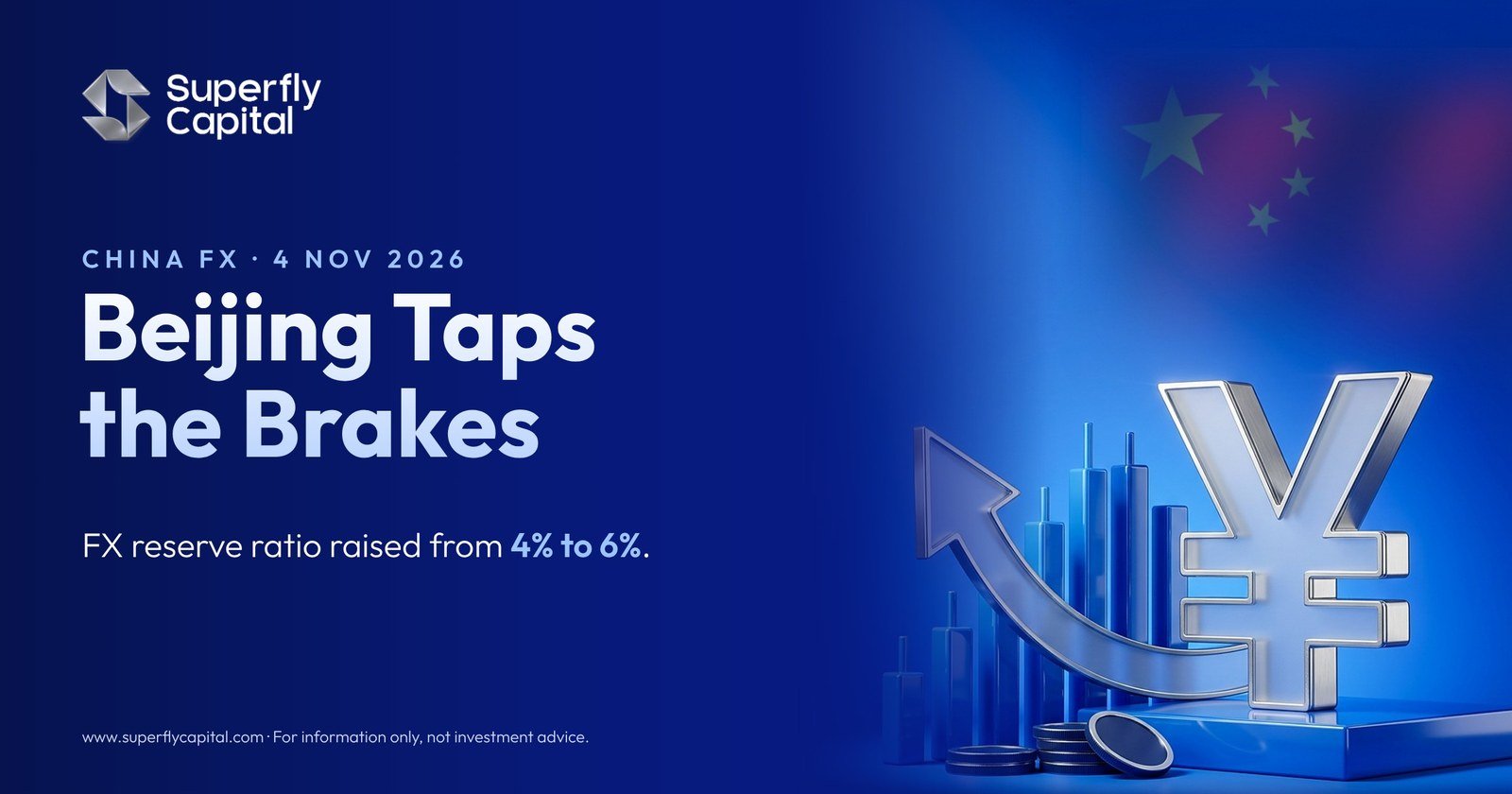
Most central banks spend their time trying to stop a currency from falling. This week, China's did the opposite. On 3 November, the People's Bank of China (PBoC) announced it will raise the foreign currency reserve requirement for banks from 4% to 6%, effective 15 November. It is the first increase since December 2021, and it comes after the yuan climbed to its strongest level in more than four years.
What happened
The yuan closed at 6.6458 per dollar on 2 November, its strongest in over four years. It has gained about 5% against the dollar in 2026, making it one of Asia's best-performing currencies, supported by strong exports, large trade surpluses and heavy conversion of export dollars into yuan by companies.
| The move | |
|---|---|
| Measure | FX reserve requirement ratio |
| Change | 4% to 6% |
| Effective | 15 November 2026 |
| Last raised | December 2021 |
| Dollar liquidity absorbed | About $24B (Reuters estimate) |
The market got the message. The yuan fell about 0.3% the next day, its biggest one-day drop since May. The PBoC also set its daily midpoint at 6.7150, weaker than expected for the second day in a row.
How the lever works
Banks in China hold foreign currency deposits, mostly dollars. The FX reserve requirement sets how much of those deposits they must park with the central bank instead of lending or trading. Raising it from 4% to 6% means banks have fewer dollars available. With fewer dollars in the system, it becomes harder and more expensive to sell dollars for yuan, which takes some heat out of the yuan's rise.
The PBoC has used this lever in both directions:
- December 2021: raised to 9% to slow a rising yuan.
- September 2022: cut to 6% to slow a falling yuan.
- September 2023: cut to 4% as the yuan weakened further.
- November 2026: raised to 6% to slow a rising yuan again.
The tool is the same. Only the direction changes.
What it tells investors
- Speed is the signal. Beijing is comfortable with a stronger yuan. It is not comfortable with a fast one. As one economist told Reuters, the PBoC sent a clear message that it was concerned about the pace of appreciation in October. In managed currencies, the pace of a move can matter more than its direction.
- Watch the fixing. The daily midpoint is often the first place the central bank shows its hand. Two weaker-than-expected fixings in a row came before and alongside the policy change.
- Policy can reverse momentum quickly. Anyone positioned for a one-way move in the yuan saw that view tested in a single session.
Why it matters for the Gulf
The UAE dirham is pegged to the US dollar, so every move in the yuan against the dollar flows directly into the cost of trade between the UAE and China, one of its largest trading partners. A slower, steadier yuan means more predictable costs for importers, exporters and businesses with exposure on both sides.
The investor's takeaway
Currencies that are managed by policy do not move like free-floating ones. The central bank's signals, from reserve requirements to the daily fixing, often matter as much as trade data or interest rates. Policy sets the pace. Discipline sets the size.
Sources
- Caixin Global, FX reserve requirement raised to 6%
- Reuters via Business Recorder, yuan's biggest drop since May
- Reuters via Lufkin Daily News, about $24B withdrawn
- Reuters via Yahoo Finance, Asian FX on 4 November
- investingLive, December 2021 increase
- FXStreet, September 2022 cut
- investingLive, September 2023 cut
See the systems behind the research
Review the live track record, then book a short call.